















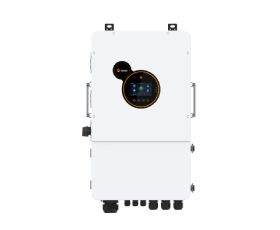

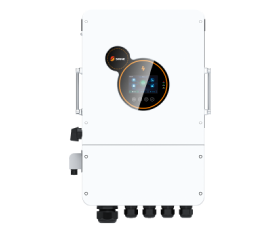

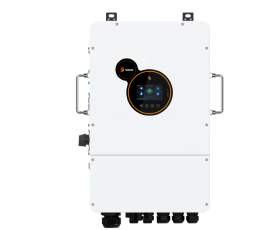
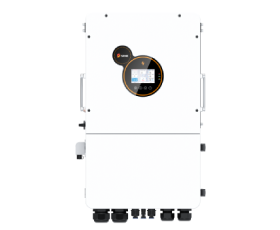






















Hybrid Inverter vs Normal Inverter: Which Is Better?
Choosing between a hybrid inverter and a normal inverter involves more than comparing features or prices. Both convert solar energy into usable electricity, but they differ in how they support battery storage, energy management, and future system requirements.
This guide compares their key differences, costs, and practical applications to help homeowners and installers determine which inverter is better suited to their solar system.
What Is the Difference Between a Hybrid Inverter and a Normal Inverter?
Both hybrid and conventional grid-tie inverters convert solar-generated DC electricity into AC power for household or commercial use. As explained by the U.S. Department of Energy (DOE), this conversion makes electricity from photovoltaic panels suitable for most electrical appliances.
The main difference is how they handle electricity beyond immediate solar consumption. A normal inverter, referring here to a conventional grid-tie model, supplies solar power to connected loads or the utility grid, while battery integration typically requires additional equipment.
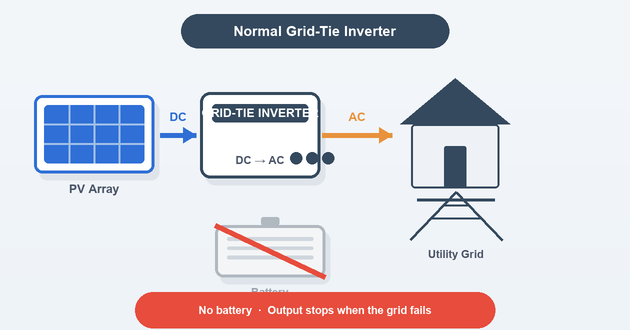
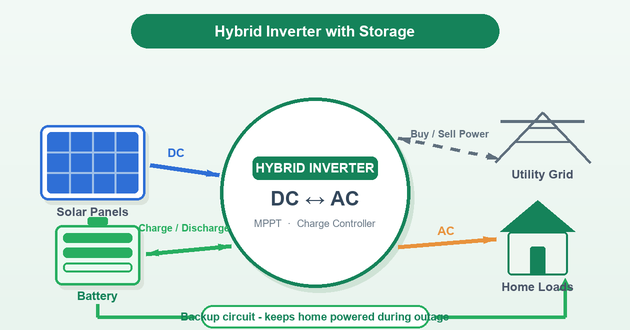
A hybrid inverter, by contrast, can coordinate solar generation with compatible battery storage, allowing electricity to be retained for later use. The DOE notes that energy storage enables electricity generated during high-production periods to be used when demand is higher, including after sunset.
Hybrid Inverter vs Normal Inverter: Key Differences
| Feature | Normal Grid-Tie Inverter | Hybrid Inverter |
| Primary Function | Converts PV electricity into AC for loads and grid export | Converts PV electricity and coordinates compatible battery storage |
| Battery Connection | Usually requires additional storage equipment | Supports compatible batteries on models designed for storage |
| Energy Management | Mainly manages solar generation and grid interaction | May control solar use, battery charging, discharge, and grid exchange |
| Backup During Outages | Normally stops grid-connected output | Backup possible with supported hardware and configuration |
| Solar Self-Consumption | Uses solar electricity when generated | Can store surplus electricity for later consumption |
| Installation | Generally simpler for PV-only systems | Additional battery, protection, and configuration requirements |
| Initial System Cost | Usually lower without storage | Generally higher when batteries and backup equipment are included |
| Future Storage Expansion | May require separate battery equipment or inverter replacement | Often offers a more direct storage integration path, subject to compatibility |
The comparison shows that a hybrid inverter provides more options for managing electricity over time. However, those additional functions create value only when the installation has a reason to use them.
How Does Battery Storage Affect the Choice Between a Hybrid Inverter and a Normal Inverter?
Battery storage is one of the main factors separating a hybrid inverter from a conventional grid-tie inverter. Instead of relying only on solar electricity available at the time of generation, a hybrid system with compatible batteries can store energy and make it available later.
As the U.S. Department of Energy explains, solar production does not always coincide with electricity demand. Storage allows energy generated during periods of higher production to be used when demand increases, including after sunset.
1. How Does a Hybrid Inverter Use Stored Solar Energy?
When solar production exceeds immediate electricity demand, a hybrid inverter can direct surplus energy to compatible batteries. As generation declines, the system can discharge stored energy to supply part of the building's load, reducing its dependence on grid electricity.
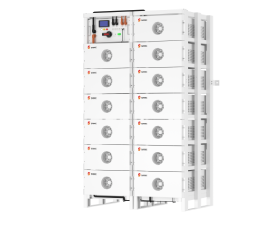
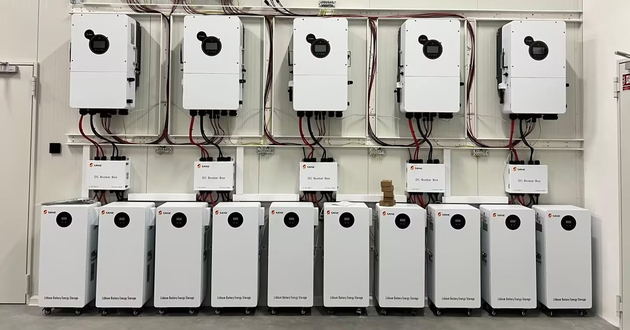
This matters particularly for facilities where electricity use continues beyond peak solar hours. At an SRNE factory installation in Poland, a hybrid inverter system was paired with 143.3kWh of lithium battery storage to provide an energy reserve alongside solar generation. How much of that energy can be used, and for how long, depends on the battery's usable capacity, discharge limits, and the factory's actual electricity demand.
2. Can a Hybrid Inverter Provide Backup Power During an Outage?
A conventional grid-tie inverter generally shuts down when utility power is lost to prevent unsafe islanding. A backup-capable hybrid inverter, however, can continue supplying designated loads if the installation supports independent operation with suitable batteries and electrical isolation.
The U.S. Department of Energy's guidance on solar resilience confirms that solar panels alone generally cannot power a home during a grid outage; independent operation requires a properly configured inverter and storage system.
Before selecting a hybrid inverter for backup, check its rated backup output, battery discharge capability, and the loads connected to the backup circuits. Supporting essential equipment during an outage is different from supplying an entire building at full demand.
When Is a Hybrid Inverter Worth the Extra Cost?
A hybrid inverter is worth the extra cost when battery storage can reduce grid electricity purchases or provide backup power that the property actually needs. The question of whether these benefits justify the higher price also appears in a Reddit discussion about hybrid inverter value, where users consider whether the additional functionality is useful for their particular solar system.
For everyday electricity use, the decision largely depends on local tariffs and consumption patterns. If exported solar electricity receives low compensation, storing surplus energy for use during expensive periods may reduce electricity bills. However, those savings need to be compared with the cost of the complete installation. The U.S. Department of Energy's solar PV cost benchmarks assess system costs across separate categories, including inverters, energy storage, electrical equipment, installation work, and ongoing operation and maintenance. This provides a more realistic basis for comparing solar-only and solar-plus-storage investments.
Backup power can also justify additional spending, particularly where outages affect essential household equipment or business operations. In contrast, for properties with reliable grid electricity, favorable solar export rates, and no plans for battery storage, a conventional grid-tie inverter may be the more economical option.
Can You Upgrade a Normal Inverter to a Hybrid Solar System?
Yes. An existing grid-tie solar system can often be upgraded with battery storage, but replacing the inverter is not always necessary. The appropriate method depends on the existing equipment, battery requirements, and whether backup power is needed.
This question appeared in a Reddit discussion about switching from grid-tie to hybrid solar, where a homeowner with a five-year-old system wanted to add batteries without rewiring the entire rooftop array. There are two main ways to approach this upgrade.
1. Replace the Existing Inverter with a Hybrid Inverter
Replacing a conventional grid-tie inverter with a compatible hybrid model allows solar generation and battery storage to be managed within one inverter system. Existing solar panels may remain in place, provided their electrical configuration meets the new inverter's requirements.
Before replacement, installers should check PV string voltage, input current, MPPT limits, battery compatibility, and grid connection requirements. Some installations may also need changes to the electrical panel or backup circuits, so upgrading is not necessarily a simple inverter swap.
2. Add AC-Coupled Battery Storage
An alternative is to keep the existing grid-tie inverter and install a separate battery inverter with compatible storage. In this arrangement, the battery system connects on the AC side rather than requiring the solar panels to be rewired directly into a new hybrid inverter.
The National Renewable Energy Laboratory (NREL) identifies AC coupling as a common approach when batteries are added to existing residential PV systems, partly because it can avoid replacing existing solar wiring. However, system compatibility, additional power conversions, and backup controls still need to be considered.
Neither approach is suitable for every installation. A replacement hybrid inverter may simplify integrated control, while AC coupling can preserve existing equipment. The final choice should be based on the current system's condition, required storage capacity, and the cost of the complete upgrade.
Which Inverter Is Better for Your Solar System?
Choosing between a hybrid inverter and a normal inverter starts with how electricity is used at the property. A conventional grid-tie inverter is often sufficient for systems focused on daytime solar generation and grid export, while a hybrid inverter is more suitable when battery storage, energy management, or backup operation is part of the system plan.
For residential installations, daily consumption patterns and future storage requirements are particularly important. Homes that use most of their electricity during daylight hours may not need batteries immediately. However, households with substantial evening demand or plans for backup power should evaluate a hybrid system's battery compatibility and supported output capacity.
The same considerations apply to commercial facilities, although their electrical demands are often more complex. In the Poland factory project discussed earlier, SRNE used HESP 12kW hybrid inverters as part of a solar-plus-storage configuration. The installation illustrates how inverter selection can be considered alongside battery capacity when planning a system for a facility with ongoing electrical demand. It does not, by itself, establish the factory's actual load profile or measured operating benefits.
Rather than assuming that one inverter type is always better, homeowners and installers should compare the available grid supply, electrical load requirements, future battery plans, and supported operating modes before selecting equipment.
Frequently Asked Questions About Hybrid and Normal Inverters
1. Can a Hybrid Inverter Work Without a Battery?
Yes, some hybrid inverters can operate without batteries, using solar electricity to supply loads or export power to the grid. However, battery-free operation depends on the specific model, and functions such as energy storage and battery-based backup will not be available.
2. Do Hybrid Inverters and Normal Inverters Use Different Solar Panels?
Not necessarily. Both can work with conventional solar PV modules, provided the array's voltage, current, and power ratings meet the inverter's input requirements. The main differences are in the inverter's system functions, not the type of solar panel used.
3. Is a Hybrid Inverter More Efficient Than a Normal Inverter?
Not always. Conversion efficiency varies by model and operating conditions. Although hybrid inverters can increase the amount of solar energy used on-site through battery storage, charging and discharging introduce additional losses. Their main advantage is flexibility in energy use rather than inherently higher conversion efficiency.
4. Can You Connect Multiple Hybrid Inverters Together?
Some hybrid inverters support parallel operation to increase total system capacity, but this capability is model-specific. Installers must verify the permitted number of units, phase configuration, communication requirements, and battery compatibility before designing a multi-inverter system.
Conclusion
A normal grid-tie inverter is a practical choice for solar systems focused on immediate electricity consumption and grid export. A hybrid inverter offers greater flexibility when battery storage, energy management, or future expansion is part of the plan.
The better choice depends on how the system will be used, not simply which inverter has more features. From residential installations to larger solar storage projects, matching inverter capabilities with actual power requirements is essential. SRNE offers hybrid inverter solutions for different solar and energy storage configurations.
References
1. U.S. Department of Energy (DOE). Solar Photovoltaic System Design Basics.
https://www.energy.gov/cmei/systems/solar-photovoltaic-system-design-basics
2. U.S. Department of Energy (DOE). Solar Integration: Solar Energy and Storage Basics.
https://www.energy.gov/cmei/systems/solar-integration-solar-energy-and-storage-basics
3. U.S. Department of Energy (DOE). Solar and Resilience Basics.
https://www.energy.gov/cmei/systems/solar-and-resilience-basics
4. U.S. Department of Energy (DOE). Solar Photovoltaic System Cost Benchmarks.
https://www.energy.gov/cmei/systems/solar-photovoltaic-system-cost-benchmarks
https://docs.nrel.gov/docs/fy19osti/73822.pdf
6. Reddit — r/SolarDIY. Are Hybrid Inverters Good/Worth It?
https://www.reddit.com/r/SolarDIY/comments/1kkudez/are_hybrid_inverters_goodworth_it/
https://www.reddit.com/r/solar/comments/1qq5ylo/looking_to_switch_from_a_standard_gridtie_to_a/